Who’s Looney Now?
The Slippery Nature of Sanity
There is a delightful, if apocryphal, story concerning a millionaire of notable eccentricity and his buttoned-up, sensible brother. The sensible brother, weary of the other’s antics, spent years trying to have him committed to psychiatric care, arguing that his erratic behaviour was proof of a mind unhinged.
Then came the twist. The sensible brother married a famous lady of the theatre, settled a vast fortune upon her, and was promptly deserted immediately after the nuptial night, during which, it is rumoured, the bride refused to remove her tights. Upon hearing the news, the eccentric brother dispatched a telegram of succinct, devastating wit:
WHO’S LOONEY NOW?
It is a flippant anecdote, but it cuts to the bone of a problem that has plagued the courts, the medical establishment, and the unfortunate families of the afflicted for generations. We like to think we know madness when we see it. We imagine the raving lunatic, the man who believes he is Napoleon, or the poor soul conversing with hallucinations in an empty room.
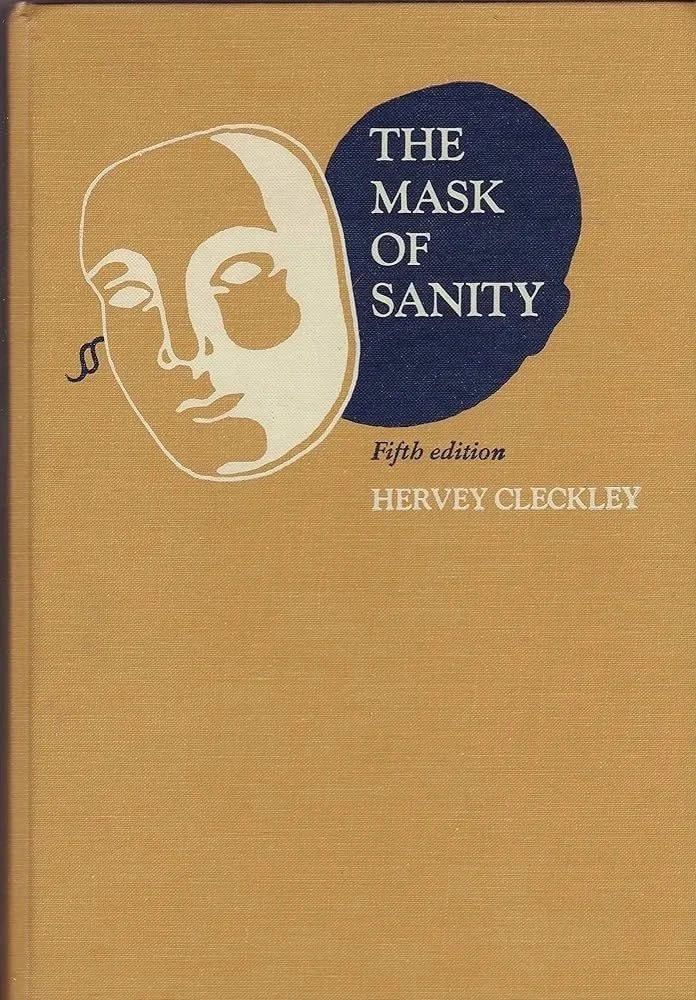
But as Dr Hervey Cleckley elucidates in his seminal work The Mask of Sanity, madness is a protean concept. It shifts. It hides. And the most dangerous form of disorder is not the one that screams from the rooftops, but the one that wears the mask of a perfectly functioning, rational human being.
The Legal Fiction of Competence
We are suffering from a hangover of definitions. In the eyes of the law, "sanity" is a clumsy yardstick. It essentially asks: does the fellow know the difference between right and wrong? Is he hallucinating? If he isn't trying to assassinate the Prime Minister because a voice from a radiator told him to, he is generally deemed "competent."
This creates a terrifying paradox. We have a class of individuals—Cleckley’s subjects—who are legally sane but biologically catastrophic. They walk among us, outwardly intact. They do not drool; they do not rave. They are often charming, intelligent, and articulate. Yet, they possess an incapacity for life that is as absolute as it is invisible.
Contrast this with the truly psychotic. Cleckley recalls a respected businessman who, after years of commercial success, began sending telegrams to the White House ordering the execution of Roman Catholics and the dispatching of the Atlantic Fleet to Madagascar. He bought 138 bird dogs and forty-two horses for no discernible reason. This is madness writ large. It is tragic, but it is tidy. We know what to do with it. We hospitalise, we treat, we pity.
But what of the man who buys nothing, hears no voices, yet systematically dismantles his own life and the lives of those around him with a chilling, smiling nonchalance? The law says he is sane. The wreckage in his wake suggests otherwise.
The Sanctity of the Crackpot
To understand this specific pathology, we must first clear away the underbrush of mere eccentricity. We must not confuse the psychopath with the crackpot.
Consider the religious zealots who handle poisonous snakes in Appalachia, convinced that the Almighty has granted them immunity to venom. Consider the followers of Wilhelm Reich—some of them highly educated intellectuals—who sat in "orgone accumulators" (wood and metal boxes), believing they were soaking up a cosmic energy that cured cancer and boosted libido.
To the sceptical eye, this is utter bollocks. It is irrational. But is it madness in the clinical sense? Cleckley argues no.
These people, however deluded their specific beliefs, are usually capable of leading useful, communal lives. They pay their taxes, raise their children, and maintain social harmony. Their beliefs, however bizarre, constitute a framework of meaning—a religion, in the deepest sense. They are integrated. They are striving for something, even if that something is a phantom.
The same applies to the "erratic genius." We forgive the poet Ezra Pound his treasonous broadcasts and his stay in a mental hospital because he produced art of enduring value. We scratch our heads at James Joyce’s Finnegans Wake—which to the uninitiated reads like the word salad of a hebephrenic on a back ward—but we recognise the intent of a functioning intellect.
These people may be odd, they may be wrong, but they are human. They participate in the shared struggle of existence.
The Hollow Men
The true subject of our inquiry—the psychopath—is defined not by what he believes, but by what he lacks.
He is distinct from the snake-handler and the eccentric poet because he lacks the capacity for a consistent life plan. He is not a man with a strange god; he is a man with no god, no purpose, and no internal compass. He is a biological organism that is outwardly perfect—he mimics the machinery of a human being with terrifying precision—but centrally, he is deficient.
He is not the "borderline" case of a known psychosis. He is something else entirely. He is the blank space where a personality should be.
We are left, then, with a disturbing realisation. Our courts and hospitals are designed to catch the man who thinks he is a poached egg. They are woefully ill-equipped to deal with the man who looks you in the eye, speaks with the eloquence of a barrister, and then proceeds to burn his life to the ground for the sheer, empty hell of it.
Until we recognise that sanity is not merely the absence of hallucination, but the presence of an integrated, feeling soul, we will continue to be duped. We will continue to look at the wreckage left by these hollow men and ask, with a bitter laugh: Who’s loony now?
We are left, then, with a disturbing realisation: our courts are designed to catch the man who thinks he is a poached egg, but are woefully ill-equipped to deal with the man who burns his life to the ground for the sheer, empty hell of it.


Event Portfolio

Street Portfolio