Unmasking the Criminal Mind
: A Radical Call for "Habilitation"
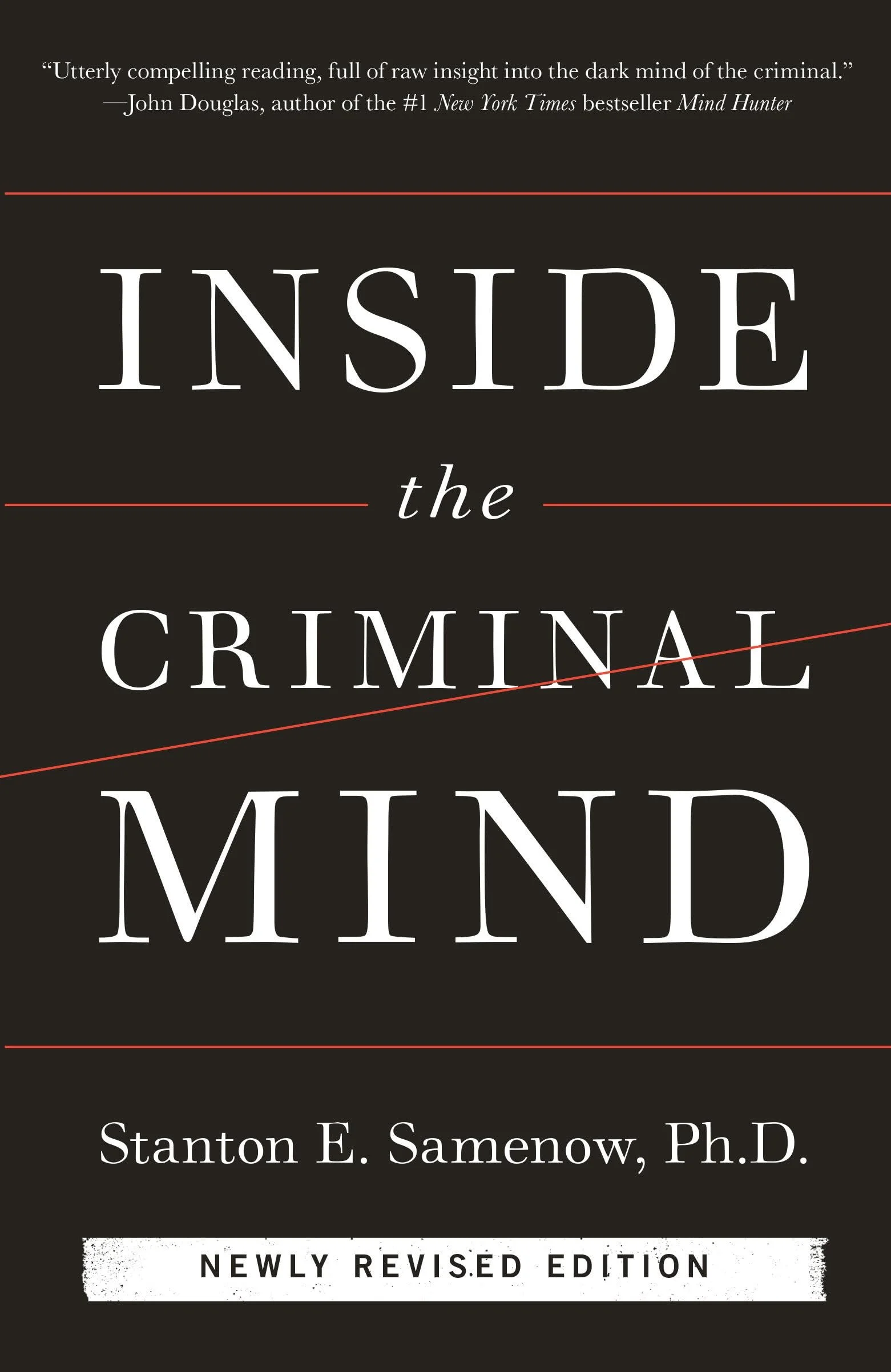
For decades, society has grappled with the persistent enigma of criminal behaviour, often clinging to notions of environmental determinism or psychological impairment. Yet, as Dr Stanton E. Samenow robustly argues in his seminal work, "Inside the Criminal Mind," such simplistic explanations fundamentally misunderstand the true anatomy of criminality. In the concluding Chapter 16, "Habilitation" or More Crime?', Samenow — a man who once shared these very misconceptions — delivers a bracing and, to some, profoundly uncomfortable truth: criminals are not merely victims of circumstance, but active architects of their own destructive "way of looking at life." His work, now spanning over forty years, presents a stark challenge to prevailing narratives and offers an equally stark, but potentially far more effective, path towards true change.
Samenow's journey began where many still reside: believing that criminals were products of their upbringing, their poverty, or their pathologies. However, working alongside Dr Yochelson, he peeled back these layers to reveal a chillingly consistent pattern of thought. Criminals, he discovered, cultivate a unique self-image forged through "overcoming and controlling others through deception, intimidation, or force." They exhibit chronic anger and a disturbing capacity to "shut off fears of consequences and conscience" to attain their desires. This isn't just bad behaviour; it's a fundamental cognitive architecture that distinguishes them from responsible individuals.
The impact of this revelation has been profound. Parents, once consumed by guilt and self-blame, found solace in understanding they weren't the "cause" of their children's criminality. Professionals, often operating in a fog of ineffective strategies, found new clarity in the concept of a "criminal mind" and its inherent "errors in thinking." Even criminals themselves, confronted with Samenow's unvarnished theories, reported a nascent ability to comprehend their own distorted thought processes — a crucial first step towards genuine transformation.
But here, Samenow draws a critical distinction. He dismisses "rehabilitation" as a misnomer, implying a return to a prior state of goodness that, for many hardcore offenders, never existed. Instead, he champions "habilitation": the arduous process of acquiring responsible living patterns anew. This isn't about tinkering at the edges; it demands an "in-depth understanding of the criminal mind" – its daily thought processes and its peculiar "phenomenological worldview." It is, in essence, a cognitive re-engineering project, aiming to systematically dismantle and rebuild the very framework of criminal thought.
The road to "habilitation," as Samenow painstakingly outlines, is not for the faint of heart, either for the offender or for society. For "hard-core criminals," only an "intensive process" will suffice; half-measures are utterly futile, akin to being "a little bit pregnant." The journey is often fraught with resistance, as criminals initially cannot grasp the magnitude of the change required. They face a stark, unwavering choice: "crime, suicide, or change." There is "no middle ground" – the door to crime, Samenow insists, must be "shut completely." He draws a potent parallel with Alcoholics Anonymous: just as one sip can condemn an alcoholic, a "minor" lie or a pilfered tool can swiftly drag a criminal back into the abyss.
So, what does this demanding "habilitation" look like in practice? Samenow details a holistic framework, applicable both within correctional institutions and, crucially, in the community:
Total Responsibility: The onus must be placed squarely on the individual. The focus shifts from external circumstances or perceived injustices to "what he does to others."
Absolute Accountability: Offenders must account for every penny spent, every hour lived. Employment, stable work patterns, and demonstrable, verifiable changes within family dynamics are not optional extras but core requirements.
No Quick Fixes: This is a marathon, not a sprint. Change is a protracted, gruelling endeavour.
Continuous Post-Release Support: Releasing a criminal without "intensive", continued guidance is a "pipe dream." The most critical phase of change unfolds in the community.
"Trial Probation" and Technological Oversight: For those not incarcerated, Samenow proposes a "trial probation" contingent on participation in intensive programmes, with failure leading to revocation. Modern technology, such as GPS monitoring, is not merely a surveillance tool but a vital enabler of "intensive" oversight, moving beyond the perilous territory of "good faith" and "hit-or-miss supervisory efforts."
The personnel tasked with this monumental challenge require a specific, rather than simply academic, skillset. Forget the notion that only highly-degreed psychologists will do. Staff, Samenow argues, must be:
Intimately Familiar with criminal thinking and behaviour patterns.
Dedicated and Acutely Resilient, understanding the "arduous" nature of the work.
Responsible Themselves – a cardinal rule, for "nothing is more futile than having one irresponsible person try to teach another irresponsible person how to become responsible."
Firm, Compassionate, and Patient: Compassion, in this context, is not pity but the commitment to "devoting considerable time and effort" to transformation.
Samenow pulls no punches regarding the "occupational hazards": the very real risk of physical assault and the insidious "rapid burnout" that gnaws at idealistic corrections staff, transforming initial zeal into jaded cynicism.
Ultimately, Samenow's most difficult truth is that criminals cannot be compelled to change. Transformation arises from an internal reckoning, a moment when they are "fed up with themselves" and genuinely yearn for an alternative to crime or self-destruction. The essence of this metamorphosis lies in the adoption of "moral values that have enabled civilisations to survive" and the arduous learning process to live without injuring others."
His closing reflections resonate with timeless wisdom, echoing concerns about fundamental human choice, free will, and the eternal struggle between good and evil. He quotes the biblical proverb, "As a man thinketh in his heart, so is he," to underscore his central thesis: to truly extricate an individual from a life of crime, one must address "what is most basic — his thinking." Samenow’s work is not for the complacent; it is a bracing, necessary confrontation with the profound complexity of the criminal mind, offering a rigorous, if demanding, blueprint for a future less marred by the scourge of crime.
Citations for this Article:
Samenow, S. E. (1984). Inside the Criminal Mind. Times Books. (The full book would be the primary citation for the content discussed).


Event Portfolio

Street Portfolio